Quantum Light-Matter
University of St Andrews
We are an experimental group at School of Physics and Astronomy) working on strong light-matter interaction, specifically exciton-polaritons.
Projects
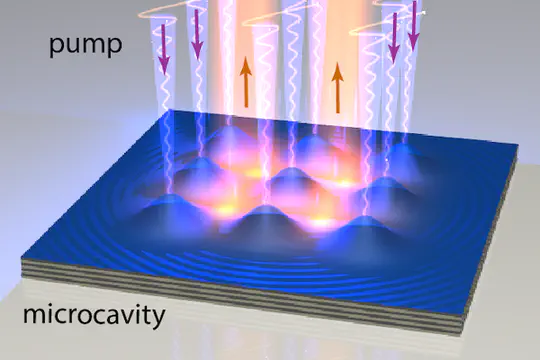
Room-temperature single polariton nonlinearity in 2-dimensional materials
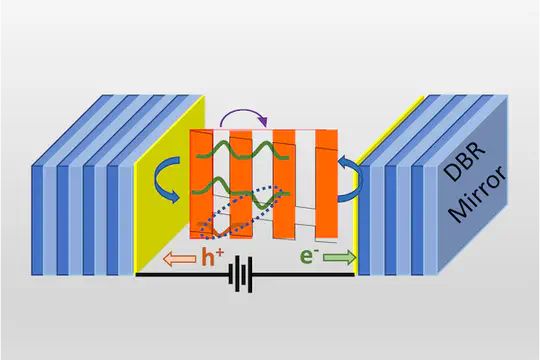
Recent Publications
Quickly discover relevant content by filtering publications.
Physical Review A 114, 033736
(2026)
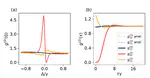
Driving the two sites of a Kerr dimer in quadrature gives unconventional photon blockade with a smooth, oscillation-free g²(τ) that standard detectors can resolve, at weak nonlinearity and without post-fabrication cavity trimming.
Science Bulletin (in press)
(2026)
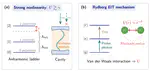
A Perspective on Cu2O Rydberg exciton-polaritons as a chip-compatible route to deterministic photon-photon interactions, setting out the obstacles to reaching U/γ ≳ 1 and a roadmap toward photon blockade and deterministic gates.
Science Bulletin
(2026)
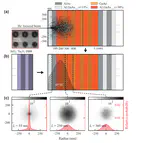
Focused He+ ion implantation imprints loss-defined traps directly into GaAs microcavities, confining polariton condensates to a mode volume of only 0.6 μm³ while preserving strong coupling — small enough to support a single condensate mode.
Nature Communications
(2025)
This work combines computation and synthesis to design and screen intercalated layered hybrid perovskites, identifying new low-bandgap materials with tunable optoelectronic properties for potential photovoltaic applications.

Light Science and Applications
(2025)
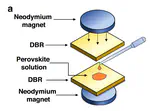
Anisotropic halide perovskite microcavities enable room-temperature photonic Rashba-Dresselhaus spin-orbit coupling and synthetic gauge fields, leading to unconventional topological states with non-zero Berry curvature.
Contact
- ho35@st-andrews.ac.uk
- Room 332, Physics and Astronomy, North Haugh, St Andrews, United Kingdom, KY16 9SS